
Peanut butter is a globally popular protein-rich food known for its smooth texture and rich flavor. Its production process involves several critical steps, each of which impacts the final product’s quality. This guide will explore peanut butter production lines, key equipment, and customization options to assist businesses looking to enter or expand into the peanut butter market. Additionally, we will share a case study of a customized peanut butter production line designed for an Algerian client.
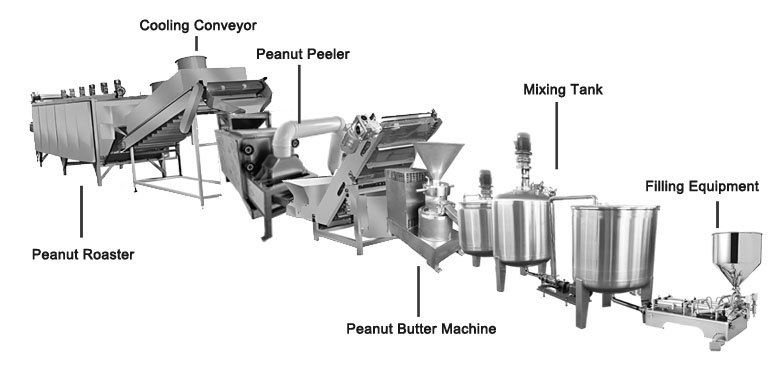
Peanut Butter Production Line: Step-by-Step Process
1. Peanut Shelling (Decortication)
The first step in the peanut butter production line is to remove the hard outer shell. Small-scale producers may use manual shelling, while industrial production employs automatic peanut shelling machines to enhance efficiency. Shelled peanuts ensure smoother processing in subsequent stages.
2. Roasting to Enhance Flavor
Roasting deepens the nut’s flavor and facilitates grinding. Industrial peanut butter making machines includes continuous roasting machines with precise temperature control to prevent burning while maximizing the release of aroma and oils.
3. Cooling and Stabilization
After roasting, peanuts must be cooled to room temperature to prevent overheating during grinding. Proper cooling ensures consistent texture and extends shelf life.
4. Peeling (Optional for a Smoother Texture)
Peanut peeling machines remove the thin red outer skin, resulting in smoother peanut butter. However, some manufacturers retain the skin to increase nutrient content such as vitamin E and iron.
5. Grinding into a smooth paste
Peanut butter grinding machine grind roasted peanuts into a smooth paste. High-quality grinders ensure uniform consistency while releasing natural oils, creating a smooth texture.
6.Degassing for a smoother texture
Bubbles formed during grinding can affect smoothness. A degassing tank removes residual air, enhancing smoothness and stability.
7.Mixing and flavoring (optional)
For flavored peanut butter (e.g., honey, chocolate), a mixer evenly blends additives. This step can be customized based on market demand.
8.Cooling and storage
Before packaging, peanut butter must be cooled in storage tanks to maintain freshness and extend shelf life.
Automatic filling and packaging
A peanut butter filling machine can portion precise amounts of peanut butter into cans, bottles, or bags. Sealing ensures hygiene and prevents contamination.
Case Study: Customized 300 kg/h Peanut Butter Production Line for an Algerian Client
On January 17, we delivered a fully automatic peanut butter production line with a capacity of 300 kg/h to an Algerian client. The production line includes: peanut shelling machine, roasting machine, peeling machine and conveyor belt, elevator conveyor, peanut butter grinder, mixer, and cooler, as well as filling and packaging machines.

This customized peanut butter production line is designed for efficiency, hygiene, and scalability, meeting the client’s requirements for high-quality peanut butter production.
Why choose our peanut butter production machine?
- Fully automatic: Reduces labor costs and enhances consistency.
- Customizable capacity: From small-scale production (50 kg/hour) to large-scale production (1,000 kg/hour).
- High-quality grinding: Ensures smooth peanut butter without lumps.
- Energy-efficient: Advanced heating and cooling systems minimize energy consumption.
- Durable and hygienic: Made from food-grade stainless steel for safety and durability.
For businesses committed to producing high-quality peanut butter efficiently, a well-designed peanut butter production line is essential. Whether you need a small-scale peanut butter making machine or fully automatic commercial equipment, our solutions can meet your production needs.
Contact us today to discuss your peanut butter processing equipment requirements and receive a customized quote!automated to ensure optimal product quality.