
In modern food processing, automated peanut butter production lines have become the key solution for achieving large-scale, hygienic, and efficient peanut butter manufacturing. From raw peanut processing to final packaging, every piece of equipment on the peanut butter line plays a critical role in determining the final product’s quality, texture, and flavor.
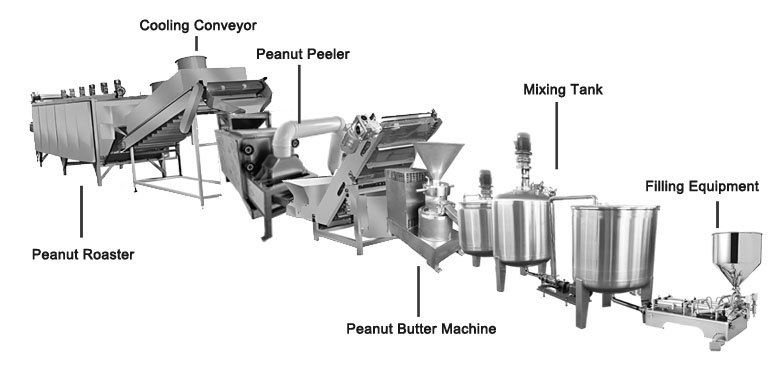
A well-structured peanut butter production line not only enhances production efficiency but also ensures the safety and consistency of the peanut butter produced, meeting domestic and international market standards.
1. Raw Material Pre-processing Equipment
Raw material pre-processing marks the initial stage of peanut butter production. Its primary objectives are to remove impurities, clean the peanuts, and roast them to achieve optimal grinding conditions. Typical pre-processing components include:
- Peanut shelling machine: Removes peanut shells and skins to yield clean peanut kernels.
- Peanut sieving machine: Sorts peanuts according to size and removes broken pieces.
- Peanut washing machine: Cleans peanuts to eliminate dust, soil, and residual impurities.
- Peanut roasting machine: Evenly roasts peanuts to enhance aroma and reduce moisture content.
This pre-processing stage ensures peanuts are clean, uniformly sized, and ready for grinding, directly impacting the final peanut butter’s quality.
2. Grinding Equipment—The Core of the Peanut Butter Machine
The peanut butter grinding machine (also known as a peanut butter making machine or colloid mill) is the heart of the production line. It determines the peanut butter’s fineness, smoothness, and flavor.
High-performance peanut butter machines utilize high-speed rotation and shear forces to grind roasted peanuts into a fine, uniform paste. Some advanced models feature cooling systems to prevent overheating, thereby preserving the natural flavor and nutritional content of the peanuts. Based on production capacity and product requirements, you can choose:
- Single-stage peanut butter grinder (for grinding fine peanut butter)
- Multi-stage peanut butter grinder (for grinding ultra-fine peanut butter)
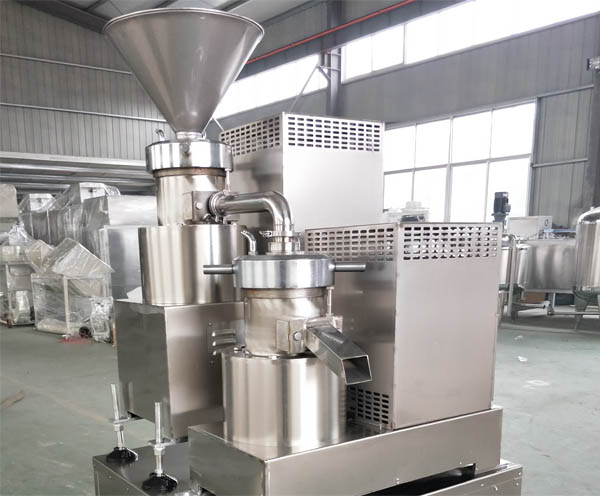
Modern peanut butter production lines typically employ food-grade stainless steel colloid mills that meet sanitary standards, enabling continuous operation for industrial-scale production.
3. Blending and Mixing Equipment
Ground peanut butter requires blending with other ingredients such as sugar, salt, or stabilizers. Mixing systems ensure product uniformity and consistent texture. Typical equipment includes:
- Blending tanks and mixing cylinders equipped with automatic temperature control and agitation systems.
- Optional vacuum mixing systems to eliminate air bubbles, enhance product smoothness, and extend shelf life.
This stage guarantees consistent peanut butter flavor and prevents separation during storage.
4. Filling and Packaging Equipment
Peanut butter filling machines precisely dispense finished product into jars, bottles, or pouches. Modern filling equipment combines high precision with automation for efficient, hygienic operation.
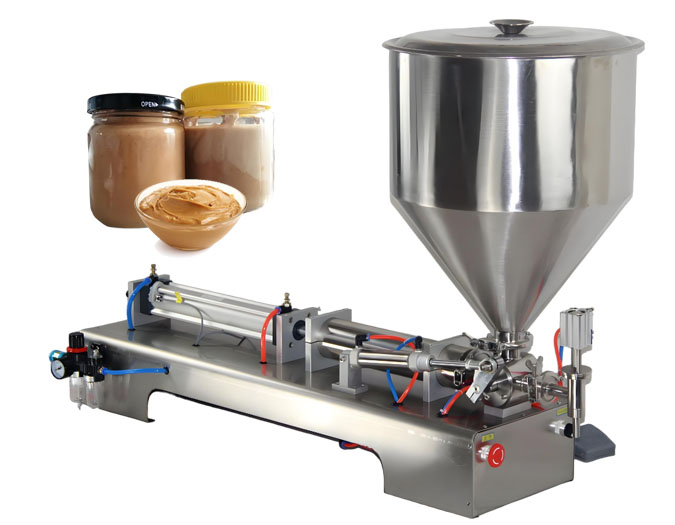
- Automatic weight control ensures precise filling volumes
- High-speed filling nozzles prevent dripping
- Integrated capping and labeling machines on the same production line streamline packaging
A well-designed peanut butter packaging system boosts production efficiency while enhancing the overall appearance and market competitiveness of the final product.
5. Auxiliary Equipment
Beyond the main machinery, auxiliary equipment supports continuous, efficient operation of the entire production line. This includes:
Conveyor belts for transferring materials between processing stages
- Cooling systems to maintain optimal product temperatures
- Storage tanks for holding intermediate products
- CIP (Clean-in-Place) systems for automated cleaning and sanitation maintenance
Auxiliary systems ensure smooth, safe peanut butter production line operation while meeting food industry hygiene standards.
6.Advantages of the Complete Peanut Butter Production Line
The fully automated peanut butter production line offers numerous benefits:
- High production efficiency with low labor costs
- Consistent product quality and uniform texture
- Enhanced food safety and compliance with sanitary regulations
- Customizable configurations for varying capacities and product formulations
These benefits make the peanut butter production line ideal for both small-scale peanut butter processing plants and large industrial peanut butter factories.
In a word, the equipment configuration of peanut butter production line is a systematic project, which needs to comprehensively consider many factors such as raw material properties, production scale and product requirements. Through rational allocation of various equipment, production efficiency can be improved, production cost can be reduced, and product quality and safety can be ensured.